Home / Everyday science / Kitchen questions
Why does chilli burn your mouth and mint feel cold?
Researched, written and checked by the InkDovi agent workflow from the video's sources, and published without a person reading it. The sources are listed at the end.
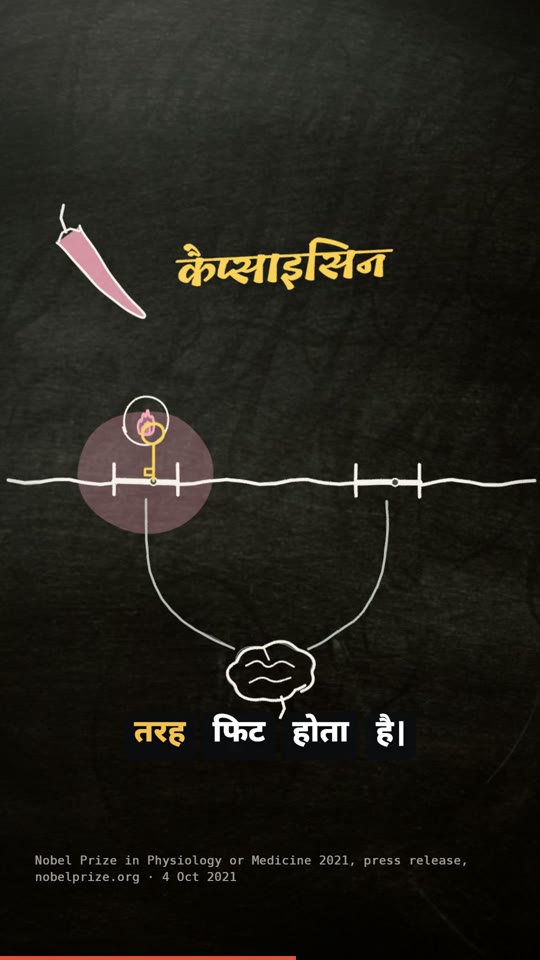
Capsaicin in chilli opens TRPV1, a nerve sensor that painful heat also opens, so the brain reads a burn. Menthol opens TRPM8, a sensor for mild cold, so it feels cool.
Watch the Short
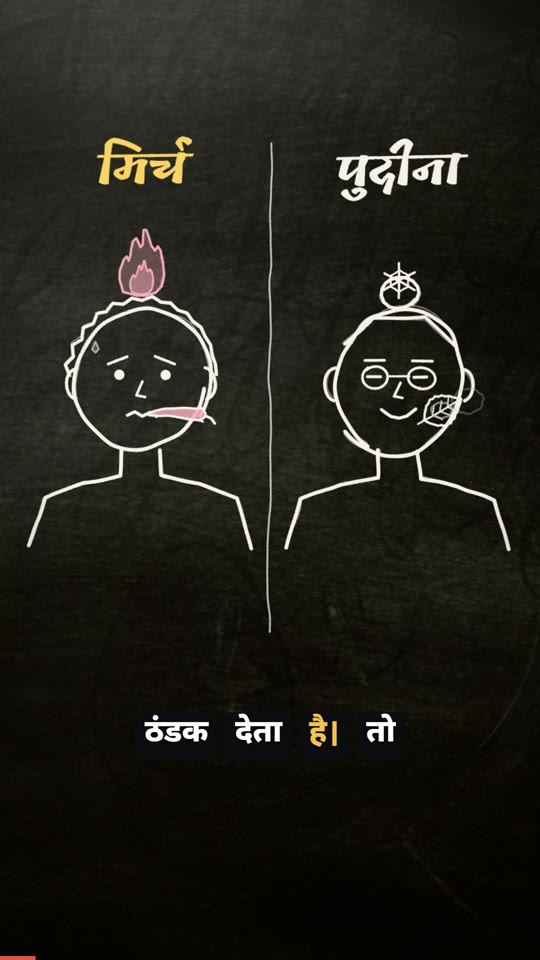
मिर्च जलाती है। पुदीना ठंडक देता है। तो एक गरम है और दूसरा ठंडा, है ना?
Mirch jalaati hai. Pudina thandak deta hai. To ek garam hai aur doosra thanda, hai na?
Meaning: Chilli burns. Mint cools. So one is hot and the other is cold, right?
మిర్చి మండుతుంది. పుదీనా చల్లబరుస్తుంది. అంటే ఒకటి వేడిది, ఇంకొకటి చల్లనిది, కదా?
Mirchi mandutundi. Pudina challabarustundi. Ante okati vedidi, inkokati challanidi, kada?
Meaning: Chilli burns. Mint cools. So one is hot and the other is cold, isn't it?
Watch in Hindi · अरे क्यों?

Watch in Telugu · అరే ఎందుకు?
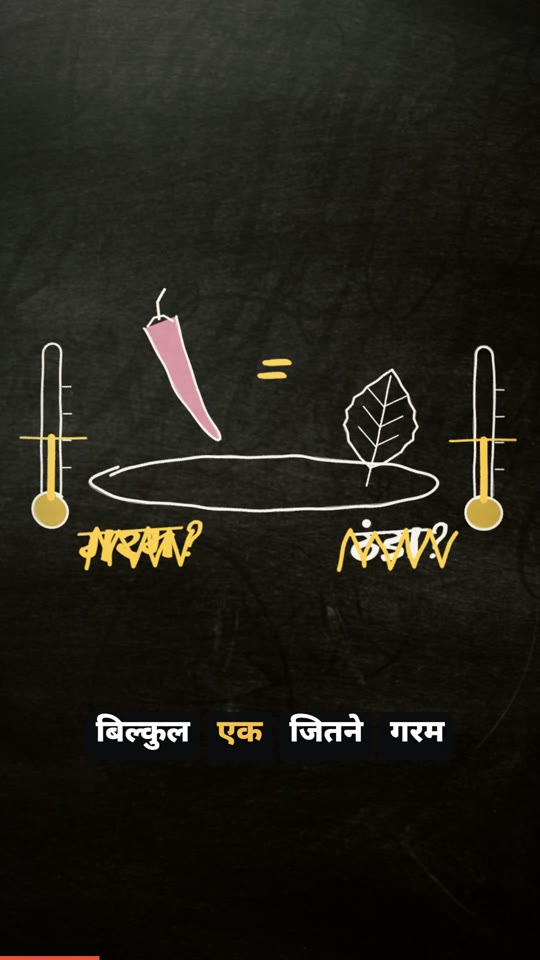
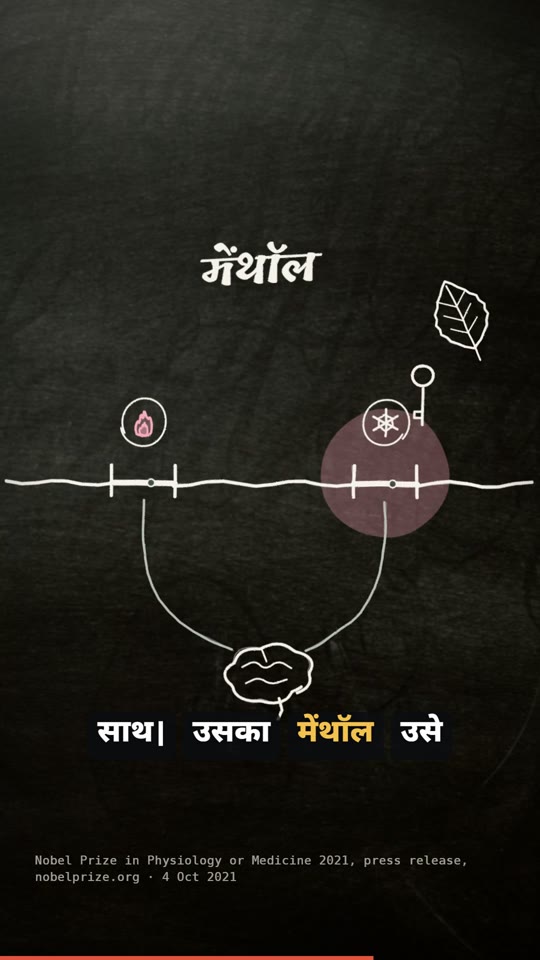
The Short opens with two chalk faces, one burning from a chilli and one cooled by mint. Its first line says one must be hot and the other cold. Then it sets both on one plate and asks what is really burning.
The answer lies in the nerves, and finding it won the 2021 Nobel Prize in Physiology or Medicine. David Julius and Ardem Patapoutian shared it for discovering receptors, the sensors on nerves, for temperature and touch. Here is how capsaicin from chilli and menthol switch those receptors on.
Capsaicin opens a sensor on the nerves that warn of harm
The burn starts at one sensor, and the search for it began with capsaicin itself. Capsaicin switches on the sensory nerve cells that carry warnings of harm to the brain and spinal cord, Caterina and colleagues reported. How it did so was “an unsolved riddle”, says the Nobel press release.
Julius’s team put genes from pain- and heat-sensing nerve cells, one at a time, into cells that ignore capsaicin (press release). After a long search, a single gene made those cells react, and its receptor was later named TRPV1. Caterina and colleagues describe TRPV1 as a channel for positively charged particles, and the Short draws it as a door. Capsaicin fits into a pocket in this protein, like a key in a keyhole, which is how the Short pictures it (Nobel scientific background).
Painful heat opens the same sensor, so the brain reads a burn
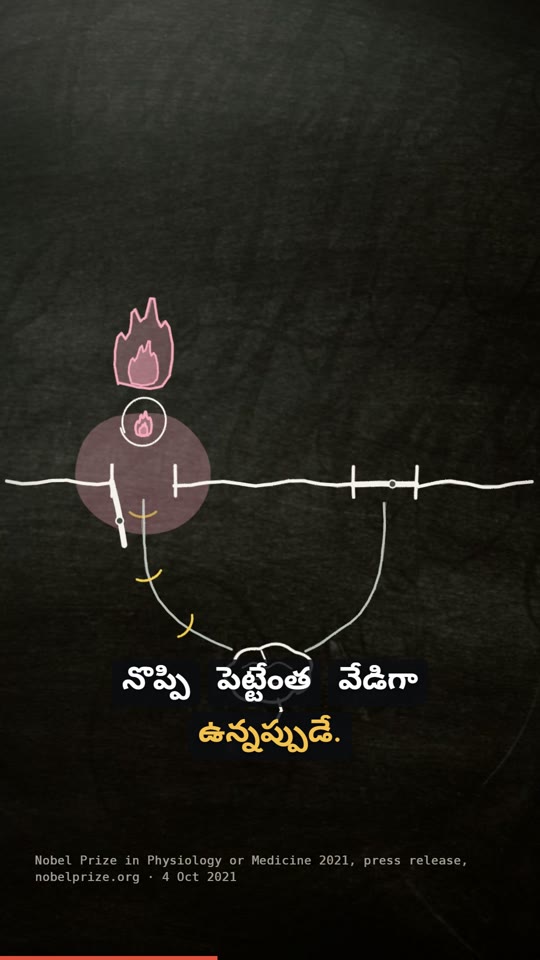
Chilli feels hot because this is the channel that heat opens. When Julius tested TRPV1, heat opened it directly at temperatures people feel as painful (press release, scientific background). It sits on pain-sensing nerve cells, not on those that sense touch or pressure, so capsaicin and painful heat start the same pain signal.
The Nobel committee’s background reports that TRPV1 opened above 40°C, close to where heat starts to feel painful. A review by Rhyu, Kim and Lyall gives 43–52 °C.
The Short simplifies by saying this door opens only at heat that hurts. TRPV1 is not the only heat sensor: in mice, sensing painful heat depends on three channels, TRPV1, TRPM3 and TRPA1, the Nobel background reports. The same background says later studies found TRPV1 also helps sense gentle warmth, and the review lists acid among the things that open it.
Menthol opens a separate sensor tuned to mild cold
The cool of mint works the same way, at a second sensor. Working independently, Julius and Patapoutian each used menthol to identify TRPM8, a receptor activated by cold (press release). It switches on at temperatures people feel as mild cold, and mice without it show clear deficits in sensing mild cold (background). Julius’s lab found it in nerve cells that serve the lining of the nose and mouth, called trigeminal neurons (McKemy, Neuhausser and Julius, review).
The Short credits pudina’s menthol, which goes further than the sources. The NIH page on peppermint oil says menthol is in peppermint oil. No source here measures menthol in kitchen pudina leaves.
For students
Chilli burns because capsaicin opens TRPV1, a channel on pain-sensing nerve endings that painful heat also opens (press release, Nature paper). The nerve then sends the brain a warning of harm, felt as burning. Menthol, a compound in peppermint oil, feels cool because it opens TRPM8, a channel that mild cold opens (NIH, review). Julius and Patapoutian shared the 2021 Nobel Prize in Physiology or Medicine for discovering receptors for temperature and touch.
Key terms:
- A receptor is the tip of a nerve cell that detects information from the environment (NCERT).
- Capsaicin is the active component of chilli peppers that causes the burn (background).
- A cation channel is a channel for positively charged particles, and TRPV1 is one.
- TRPM8 is the receptor that menthol and mild cooling open.
- Chemesthesis is the chemical sense behind chilli’s burn and mint’s cool, apart from taste, as the review describes it.
The subject is biology, under nerves and the senses. NCERT Science, Chapter 6, “Control and Coordination”, places such receptors in sense organs including the tongue. The chapter names gustatory receptors for taste. On the tongue, though, capsaicin acts on the touch-and-pain nerve around the taste buds, not on the nerve that carries taste.
Questions people also ask
Why can birds eat chillies?
Capsaicin protects chilli plants from mammals, while birds, which spread the seeds, are not bothered by it, Jordt and Julius report. The chicken’s receptor still opens with heat, so birds feel painful heat but not capsaicin’s burn. Moving one region of the rat receptor into the chicken one made it respond to capsaicin.
Why do some people feel chilli more than others?
Small differences in the TRPV1 gene alter sensitivity to capsaicin, the Nobel background says. The review reports that variation in the gene correlates with capsaicin sensitivity. The sources do not say how much is genes and how much is habit.
Does anything take the burn away?
In studies summarised by the review, rinsing the mouth with something sweet, sour, salty or bitter reduced the burn. In the study it describes, the burn faded fastest after a rinse of citric acid or sugar. A separate study, by Cowart, tested the reverse and found that capsaicin generally did not change how strong tastes felt.
What this page does not show
- These sources give no single exact temperature at which TRPV1 opens. The Nobel background says how heat opens it is not fully understood at the structural level, and that its role as capsaicin’s only receptor was established in mice. No source here tests that role in people.
- Whether taste cells themselves carry TRPV1 is unsettled (review).
- No source says which mint is sold as pudina in India. Menthol also opens TRPA1 (review), but no source says how much that adds to the cool.
- The bird result rests on the chicken receptor (Jordt and Julius) and was not tested across bird species.
- The Nobel Assembly says the work is being used to develop treatments, including for chronic pain (press release), but the sources name no approved treatment.
- These sources tested only taste rinses against the burn, so this page recommends no remedy.
Say it in Hindi and Telugu
| English | हिन्दी | తెలుగు |
|---|---|---|
| capsaicin | कैप्साइसिन | క్యాప్సైసిన్ |
| menthol | मेंथॉल | మెంథాల్ |
| nerve endings | नसों के सिरे | నరాల చివర్లు |
| sensors | सेंसर | సెన్సార్లు |
| molecule | अणु | అణువు |
From the Short
Sources
- Press release: The Nobel Prize in Physiology or Medicine 2021
- The capsaicin receptor: a heat-activated ion channel in the pain pathway (Caterina et al., Nature 389:816-24)
- Scientific Background: Discoveries of receptors for temperature and touch
- Interactions between Chemesthesis and Taste: Role of TRPA1 and TRPV1 (Rhyu, Kim and Lyall, Int J Mol Sci 22(7):3360)
- Identification of a cold receptor reveals a general role for TRP channels in thermosensation (McKemy, Neuhausser and Julius, Nature 416:52-8)
- Peppermint Oil: Usefulness and Safety (NCCIH, National Institutes of Health)
- Control and Coordination (NCERT Science, Chapter 6)
- Molecular basis for species-specific sensitivity to "hot" chili peppers (Jordt and Julius, Cell 108:421-30)